Keyword density has been an SEO topic for more than 20 years.
It was once one of the most important ranking factors — but today, it is still misunderstood by many bloggers and website owners.
Some people believe repeating a keyword many times helps rankings.
Others think keyword density no longer matters at all.
The truth lies somewhere in between.
In this complete guide, you’ll learn what keyword density really is, why it still matters in modern SEO, the ideal keyword density for 2025, and how to optimize keywords naturally without risking penalties.
What Is Keyword Density? (Simple Definition)
Keyword density is the percentage of times a target keyword appears compared to the total number of words on a page.
For example, if a blog post contains 1,000 words and the keyword appears 10 times, the keyword density is 1%.
Keyword density helps search engines understand what a page is about, but it is not the only ranking factor in modern SEO.
🟦 Why Keyword Density Still Matters in 2025
Many SEO beginners think keyword usage no longer matters because Google now uses artificial intelligence, semantic analysis, and machine learning.
While Google is much smarter today, keyword density still plays an important supporting role in SEO for several reasons:
- It helps Google understand the main topic of a page
- It supports search intent matching
- It improves relevance scoring
- It prevents topic dilution when keywords are used too little
Keyword density does not rank pages by itself, but it strengthens on-page SEO when used naturally.
Google explains keyword usage in its search documentation.
🟦 The Ideal Keyword Density for SEO (2025)
The recommended keyword density range for 2025 is:
⭐ 0.8% – 1.5%
This range is widely used by top-ranking pages because it feels natural, avoids keyword stuffing, and provides clear relevance signals.
Examples:
- 1,000 words → 8–15 keyword mentions
- 1,500 words → 12–22 keyword mentions
- 2,000 words → 16–30 keyword mentions
🟦 Keyword Density Formula (Easy Calculation)
Use this simple formula:
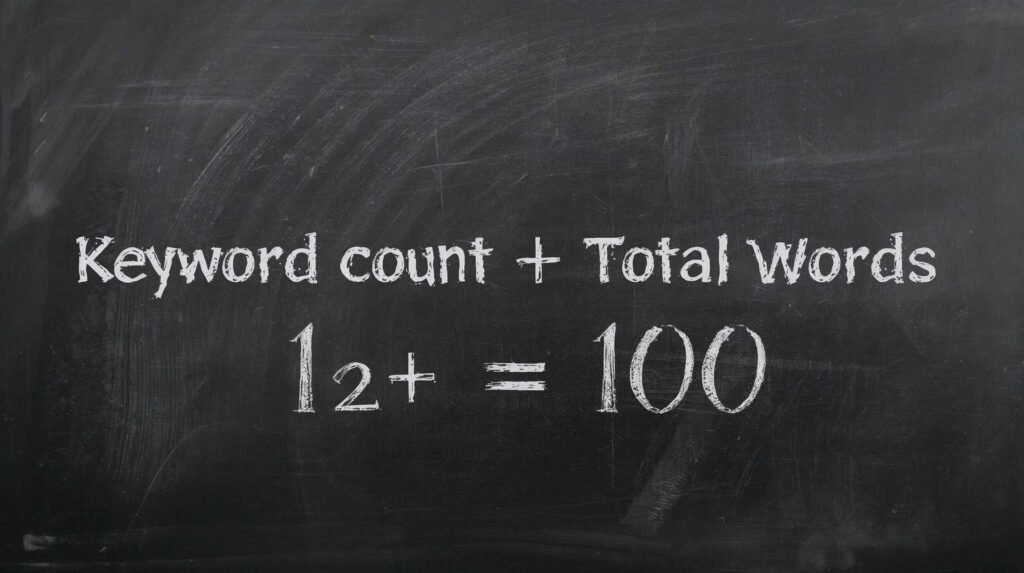
Keyword Density = (Number of Keyword Uses ÷ Total Word Count) × 100
Example:
If you use a keyword 12 times in a 1,500-word article:
Keyword Density = (12 ÷ 1500) × 100 = 0.8%
🟦 How Google Evaluates Keyword Usage Today
Google no longer focuses only on keyword density.
Instead, it evaluates several on-page signals together:
- Keyword placement (title, H1, first 100 words, headings)
- Semantic meaning and context
- Related keywords and synonyms
- Natural writing patterns
- Topic depth and coverage
Google’s NLP systems understand meaning, not just repeated words. If keywords feel forced or unnatural, rankings can suffer.
🟦 Good vs Bad Keyword Density (Examples)
✅ Good Keyword Usage
- Keyword density around 1%
- Keywords distributed naturally
- Synonyms and variations used
Example keyword: QR code generator
Used naturally alongside terms like create QR code, generate QR codes, and scan QR code.
Result: readable, helpful, and trusted by Google.
❌ Bad Keyword Usage
- Keyword density too high (3–4% or more)
- Forced repetition
- Awkward sentences
Example:
“Use our image compressor because our image compressor is the best image compressor.”
Result: keyword stuffing → lower rankings or penalties.
🟦 What Is Keyword Stuffing? (Avoid This)
Keyword stuffing happens when keywords are repeated unnaturally to manipulate rankings.
Google detects this using:
- Natural Language Processing (NLP)
- N-grams and pattern analysis
- Spam detection algorithms
Signs of keyword stuffing:
- Unnatural repetition
- Keywords forced into every heading
- Repetitive anchor text
- Cluttered sentences
Result:
- Lower rankings
- Reduced trust
- Possible spam penalties
🟦 Tools to Check Keyword Density
To measure keyword density accurately, you can use the NasajTools Text Analyzer.
It shows keyword frequency, density percentage, readability, and repetition patterns.
👉 https://nasajtools.com/tools/text/text-analyzer.html
Other helpful tools:
- Character Counter
- Google Search Console (for indirect relevance signals)
🟦 How to Use Keyword Density Naturally
Follow these professional SEO writing techniques:
- Use your keyword in important places (title, H1, URL, first paragraph)
- Write naturally and avoid forcing phrases
- Use synonyms and related keywords
- Increase article length for better distribution
- Add internal links with natural anchor text
Example:
“Use our Text Analyzer to check keyword density.”
🟦 Common Keyword Density Mistakes
Avoid these mistakes:
- Repeating the exact same keyword too often
- Adding keywords only to increase density
- Ignoring semantic keywords
- Stuffing keywords into headings
- Using the wrong keyword for search intent
🟦 Keyword Density Example (Real Breakdown)
Blog post: How to Compress Images for SEO
Word count: 1,600
Keyword usage: 12 times
Density: 0.75%
Also includes:
- compress images
- reduce image size
- image optimization
- WebP conversion
This is an example of perfect SEO writing.
🟦 Keyword Density and Semantic SEO (Advanced)
Google uses advanced NLP models such as:
- BERT
- RankBrain
- MUM
These models evaluate:
- Meaning
- Context
- Topic authority
- User satisfaction
Keyword density helps with recognition and relevance, but semantic SEO and content depth matter more.
🟦 The Role of Keyword Density in On-Page SEO
Keyword density supports:
- Title tag relevance
- Heading structure
- Content clarity
- Internal linking
- Image ALT text
- Meta description relevance
It works best as part of a complete on-page SEO strategy.
🟦 Frequently Asked Questions About Keyword Density
Does keyword density affect SEO rankings?
Yes, but only as a supporting factor.
What is the ideal keyword density?
Around 0.8% to 1.5%.
Can keyword stuffing hurt SEO?
Yes, it can lead to penalties.
Does Google have a fixed keyword density rule?
No, natural usage is expected.
Does keyword density still work in 2025?
Yes, when combined with semantic SEO.
🟦 Conclusion
Keyword density is not an outdated SEO tactic.
When used correctly, it helps Google understand your content and improves relevance without risking penalties.
To optimize keyword usage effectively:
- Keep density around 0.8%–1.5%
- Use synonyms and related keywords
- Write naturally
- Avoid keyword stuffing
- Focus on readability and user intent
Following this approach helps you write content Google trusts — and users enjoy reading